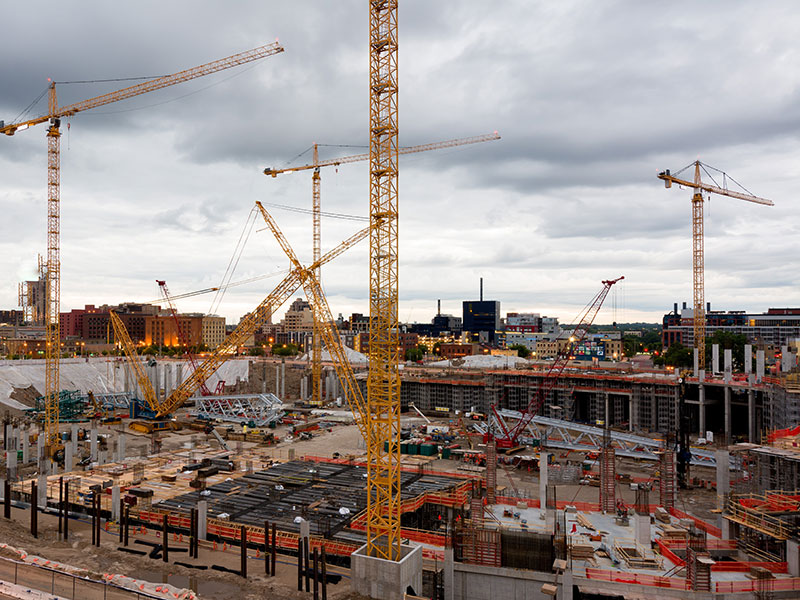
AI seems to be everywhere. Although sources suggest the text “AI” appears in daily inboxes two to five times a day, it seems like we see it several times an hour! It’s certainly evolving quickly and seems to appear everywhere. With that, it’s hard to ignore AI applications rapidly appearing in our industry. Although this new technology is commanding a lot of attention, it’s fitting to recognize how intensely technology has played a role in heavy construction throughout our industry’s history.
Just one example of a technological development is right under our own roof: industrial wire rope. Wire rope was invented in Germany during the early 1800s. Until this time, ropes made from hemp and iron chains were the primary options for use in construction and other industries. Wire rope was a solution to durability issues associated with hemp. With wire rope, the industry largely overcame the problem of mechanical failure of chains. One of our earlier blog posts describes an early application of industrial wire rope right in our hometown: A Piece of Cincinnati History that Used Early Wire Rope Technology.
Looking beyond the specifics of wire rope, the reality is that technology has been a collaborator in and with the construction industry for millennia. Going back to ancient times, people were able to build more than manual lifting or transporting would allow. Below is a very general timeline describing use of technology over the ages:
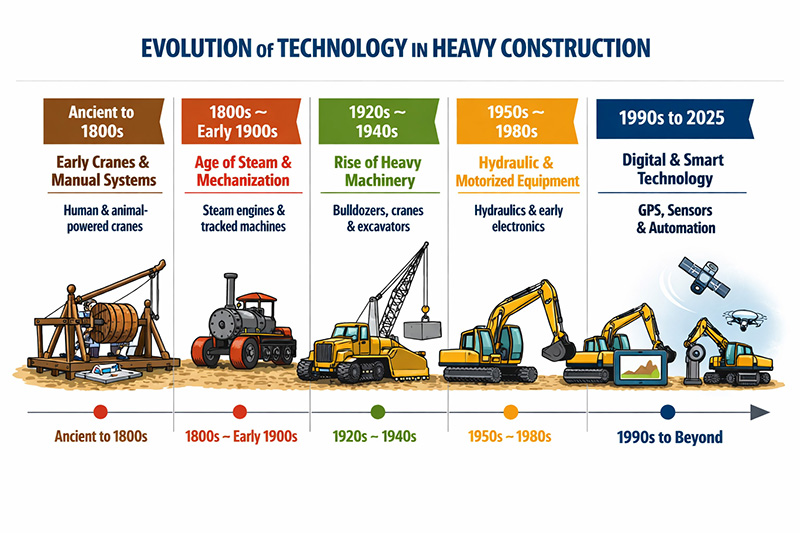
It goes without saying that wire rope remains a very important technology in our “era.” AI is never apt to take the place of a wire rope, but just a couple areas in which AI is emerging are described below.
AI in Heavy Construction: Transforming Bridge, Lock, and Infrastructure Projects Through Intelligent Lifting and Rigging
Artificial intelligence is rapidly reshaping the heavy construction sector, bringing new levels of precision, safety, and efficiency to projects that rely on complex lifting and rigging operations. From long span bridges to navigation locks, dam gates, and industrial infrastructure, AI is becoming a core tool for planning, monitoring, and executing lifts involving cranes, hoists, and wire rope systems.
AI Enhanced Lift Planning and Engineering
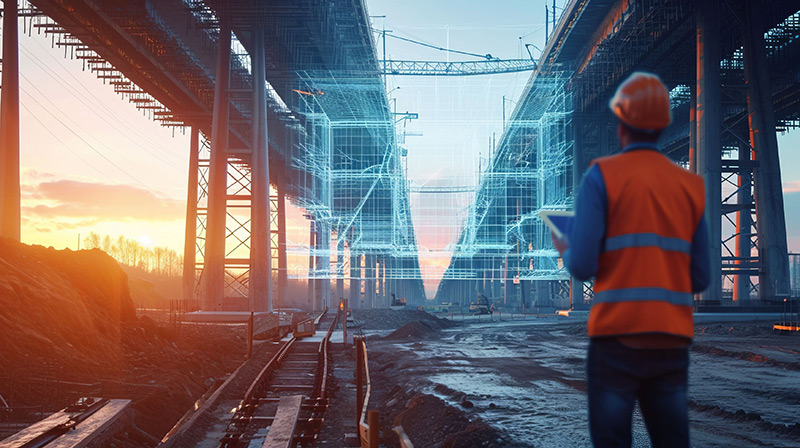
One of the most immediate applications of AI in heavy construction is in lift planning. Traditional lift planning requires engineers to manually calculate load paths, sling angles, center of gravity shifts, and crane capacities. AI driven software now automates much of this work, generating optimized lift plans based on thousands of variables.
Machine learning models can evaluate:
- Load geometry and weight distribution
- Wire rope sling configurations and tension profiles
- Crane selection and placement
- Ground bearing pressures
- Environmental conditions such as wind, temperature, and vibration
For bridge construction, where large precast segments, girders, or cable stayed components must be lifted with extreme precision, AI can simulate multiple lift scenarios and identify the safest, most efficient option. This reduces engineering hours, minimizes human error, and ensures compliance with ASME, OSHA, and project specific safety standards.
In lock and dam projects, AI based modeling helps plan lifts of massive miter gates, sector gates, and bulkheads, which often require multi crane or strand jack coordination. AI can predict how wire rope systems will behave under dynamic loads, helping engineers avoid shock loading, side loading, or uneven tensioning.
Real‑Time Load Monitoring and Predictive Safety Systems
Beyond planning and engineering, AI is also transforming the jobsite itself. Modern load cells, tension meters, and smart shackles, many integrated with wire‑rope lifting systems, now feed continuous data into AI‑powered monitoring platforms. These systems can detect anomalies long before they become hazards.
Examples include:
- Real‑time tension monitoring across multiple slings or hoists
- Predictive overload detection, identifying when a lift is trending toward unsafe conditions
- Dynamic load path tracking, showing how loads shift during picks
- Automated alerts for out‑of‑plane loading, twisting, or unexpected movement
For large bridge lifts, such as setting steel tub girders or precast deck panels, AI‑enabled monitoring ensures that each pick stays within engineered tolerances. If one sling begins to take more load than expected, the system can alert the operator instantly.
In lock and dam rehabilitation, where lifting operations often occur in confined spaces or underwater, AI‑driven monitoring improves visibility and reduces risk. When lifting heavy gates or machinery with wire‑rope hoists, AI can detect micro‑changes in tension that indicate binding, misalignment, or structural interference.
As the industry faces rising project complexity, workforce shortages, and tighter safety expectations, AI is emerging not as a futuristic add on but as a practical, field ready asset. We’ve covered just a few examples of the role AI is playing in the industry. We’ll take a look at more applications in our next blog post.
In the meantime, we’d welcome your stories on how AI has delivered greater accuracy and efficiency to your operations. Or, given it’s a technology that is always learning and evolving, let us know what missteps it may have caused.